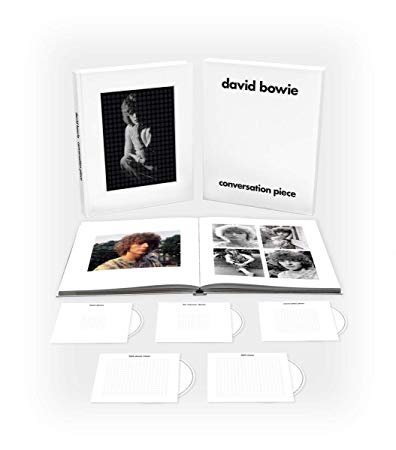
From theafterword.co.uk on Conversation Piece:
In 1968, David Bowie had been dropped by his record label, Deram, and was on the scrap heap at the age of twenty-one. Undaunted, he continued to make music in any way he could, he tried some acting, joined a mime group and became part of a ‘Folk scene’. He fell in love with dancer, Hermione Farthingale, and formed a Folk trio with John Hutchinson, developing a fondness for verbose allegorical fables. By early 1969, Farthingale left him for Norway, he appeared in a Lyons Maid ice cream commercial, was third on the bill as a mime act beneath Tyranosaurus Rex and became involved in a Beckenham Free Festival. Fortunately, for Bowie enthusiasts, he often had a tape recorder playing nearby. He made numerous demos, recorded sessions for BBC Radio and had an audition for Mercury Records captured for posterity, an audition he passed. He also starred in his own promotional film, Love You Till Tuesday.
Most Bowie watchers will be expecting part five of the ‘Five Years’ box sets, which began in 2015 before Blackstar was released. Sadly, a dispute over Tin Machine royalties is causing a delay. In the interim, Conversation Piece is a five CD box that is essentially a superdeluxe Space Oddity special, a total of seventy-five tracks. Much of the material has been released this year on vinyl or digital download but not CD: Spying Through A Keyhole, Clareville Grove Demos and The ‘Mercury’ Demos. Add to that the 2009 remaster of the Space Oddity album, a brand new 2019 Tony Visconti remix, twelve previously unreleased additional demos, John Peel’s Top Gear and The Dave Lee Travis Show sessions and a 120 page book and you have a comprehensive document of a triumph of perseverance in the face of adversity for an artist struggling to find his voice.
Many of the demos are rough, Bowie strumming chords, working his way towards coherent melodies and picking out words and narratives that seem to fit, often slipping off key or out of rhythm. Some sound like amateur Merseybeat, others seem to be aiming for Dylanesque profundity and a few want to wig-out and Rock. Folk Bowie is twee and kooky, if charming. Pop Bowie is unfocused, distracted and jaunty. Rock Bowie is trippy and hippy. The ‘Mercury’ Demos, in a duo with John Hutchinson, are a clear upgrade both in the quality of the writing and the sound, including a couple of covers. The most heartfelt wistfully romanticise Hermione. The Top Gear session features the Tony Visconti Strings. It works well, the orchestration adding a discipline and a sense of purpose to the performances. A polished single, In The Heat Of The Morning paired with London Bye, Ta Ta seems to come from another era, about four years earlier. You can hear why all these songs weren’t a success and also the potential within them. Then, like a gathering of elements coalescing together beautifully, came Space Oddity.
Space Oddity is the centrepiece of this box with nine versions tracking its development over a period of many months. Visconti dismissed it as a novelty song completely missing its serious lyrical content, its dramatic narrative arc and its musical adventurousness. Gus Dudgeon really liked the song and brought together an excellent set of musicians to perform it: Mick Wayne guitar, Herbie Flowers bass, Terry Cox drums, plus, crucially, Rick Wakeman on mellotron and Paul Buckmaster arranging the strings. Tony Visconti joined in on flutes and woodwind, while Bowie himself played acoustic guitar and stylophone. It is an outstanding single, inspired by Stanley Kubrick’s film, 2001: A Space Odyssey in which a spaceman floats alone in the eternal void, never to return. The release was perfectly timed to coincide with the launch of Apollo 11 but it only gained airplay after the crew had safely returned to Earth. A top five hit in 1969, its futuristic sound and theme of alienation has given it a long life, becoming almost synonymous with Bowie himself.
The album, properly titled David Bowie, his second with the same name, has nothing else that matches it, although that’s not for want of trying. Just as Bowie began to move forward into a new decade, a lot of the songs look backwards, some with affection, such as Memory Of A Free Festival, or with frustration, as in Cygnette Committee and Unwashed And Somewhat Slightly Dazed. The longer, more ambitious tracks tend to meander and an under-rehearsed band begin to lose patience. Wild Eyed Boy From Freecloud is made over-wrought by Visconti’s lush fifty piece orchestration, an attempt to outdo Dudgeon’s powerfully spare take as Space Oddity’s B side. God Knows I’m Good, about an elderly lady forced into shoplifting to survive, is more in keeping with his 1967 album, whereas Janine is a song tight enough to fit on Hunky Dory with its catchy chorus, florid electric guitar and subject matter of a fragmented personality. Letter To Hermione and An Occasional Dream are the most fragile and the most successful performances, largely because Visconti restrains himself. The LP ends with a quaint Hey Jude style coda celebrating a Sun machine, sung wearily by a choir including ‘Whispering’ Bob Harris and Marc Bolan. It’s a relief when it’s over.
David Bowie is a crushed velvet of an album, reeking of patchouli, embroidered cheesecloth shirts, flared jeans and long hair. It often feels like an ordeal to be endured, dropping heavy hints of the greatness to come, introducing themes that would obsess Bowie throughout his career, while remaining very much of its time.
The David Bowie 2019 remix is a marvel, Visconti’s best yet. His remixes since Bowie’s death are getting better and better. He brings out the beauty in the songs and the personality in the performances. Fortunately, it is available as a single disc and is highly recommended. The mastering throughout the rest is also excellent, certainly as good as it can be. It’s thoughtful of them to include the 2009 remaster of David Bowie rather than the 2015 that most Bowie fanatics would have bought in the Five Years box. It had ‘different goals’ apparently, intended to sound more like the vinyl. The goal of Conversation Piece, a collection of five CDs full of curiosities and oddities, almost literally, must be simply to fully document the music of David Bowie in 1968 and 1969.